Welcome to beautiful southern Missouri, Home to the first National Scenic Riverway, the Mark Twain National Forest, and the St. Francis Mountains (pre-cambrian volcanic).
Missouri has one of the most magnificent karst spring systems in the world, which feeds our clear Ozark streams. You are welcome to swim in our many creeks and rivers, but stay out of spring streams (you may not know that these are springs and not creeks until you feel how cold the water is or you hike to where the water pours out of the rock at millions of gallons per day). Fit in like a native and just swim in shorts and t-shirts. Look for the endangered Ozark hellbender in the clear streams. We also have a herd of re-introduced elk (Peck Ranch) and Missouri is experiencing a resurgence of black bears, so if you are lucky, you may spot one.
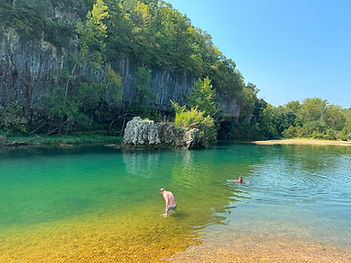
One of our practice sites is very close to an access to the Jacks Fork River- so you may want to take a dip. In addition to swimming, the Ozark streams offer an abundance of fossils amongst the rocky beaches. Crinoids, bivalves, and fossilized coral are all plentiful.
This page lists just a few of the many activities in the area. As you drive to the contest site, you will likely see many National Park and Forest signs for various places. Take whichever roads you have time for. There is always something interesting at the end of the path.
The Ticks are bad in Missouri this year!! Use Deet on you and permethrin on your clothes. I will leave a spray bottle of permethrin at each of the two housing sites. Hopefully they will calm down a bit before the end of September.
Stegall Fire Tower and rhyolite glades at Peck Ranch Conservation Area;
Very near the MOFEP housing. Look for the sign for Stegall Wilderness area in Peck Ranch and follow the one lane road to the end. Park and walk about 500 feet to the glade and fire tower. You are allowed to climb any fire towers that are not gated off. The view from the top of the fire tower is amazing.
Falling Springs: Winona
https://www.fs.usda.gov/r09/marktwain/recreation/falling-springs-picnic-ground. Beautiful old mill and spring flowing from high on a bluff wall
Cupola Pond: Handy (https://mdc.mo.gov/discover-nature/places/natural-areas/cupola-pond)
A National Natural Landmark, Cupola Pond is a 5 acre karstland sinkhole swamp located 40 foot below the surrounding ridge. It is inhabited by centuries old Tupelo trees and epiphytic sedge that are far from their normal ranges. A clay lens and a build up of peat (this is a Histisol soil- one of the few in Missouri) causes this sinkhole to hold water in all but drought years.
Clearwater Lake (https://www.swl.usace.army.mil/Missions/Recreation/Lakes/Clearwater-Lake/
Worth a look and a swim at their beach- this is an Army Corps of Engineers lake fed by the springs on the Black River
Haunted Ridge Rock: Cadet MO
https://www.facebook.com/p/Haunted-Ridge-Rocks-100066722716926/
This is about halfway between our contest site and St. Louis but I am mentioning it for any diehard rockhounds in the group. The owners dig up their land with a backhoe then let people in to look for the most amazing druzy quartz and lace agate specimens. Its $30 for a 5 gallon bucket and I regularly see people hauling off whole pickup loads of rocks.
Ozark national scenic riverways: the Current and jacks fork rivers
Ozark National Scenic Riverways was established through congressional legislation on August 24, 1964 to conserve and interpret the unique cultural and natural resources of the Current and Jacks Fork Rivers. The Riverways protects 134 miles of clear, free-flowing spring-fed waterways. The impressive karst landscape of the Riverways supports an amazing variety of features, including a spring system unparalleled in North America. Ozark National Scenic Riverways was the first federally protected river system and provided the inspiration for the National Wild and Scenic Rivers Act of 1968.
If you can arrive a day early for the contest, do a float on the Current River. Its beautiful.


Welch Spring to the left and Alley Spring above
Rocky Falls, Mark Twain National Forest
Few places in the Ozarks provide a glimpse of earth’s turbulent past as well as Rocky Falls. The reddish-brown rock you see here is rhyolite porphyry. It formed as molten rock deep within the earth and flowed onto the surface about 1.5 billion years ago. At the time, no living thing existed to see the awesome flow of glowing hot lava slowly advancing over the barren landscape.
Normally, a stream eroding softer dolomite, a type of limestone, would make a wider valley for itself. Since the rhyolite is harder, the stream tends to stay within whatever cracks that it finds, deepening them only a little by erosion. Thus a“shut in” is formed where the harder rock has “shut in” the stream. Farther downstream, past the constricting rhyolite, the stream valley widens once again. This allows the stream to expand into a pool.

Johnson Shut-Ins State Park
The rugged terrain of the St. Francois Mountains and Johnson’s Shut-Ins State Park is home to many natural landscapes like woodlands, glades and rivers. The park itself has 17 different natural terrestrial communities and supports more than 850 plant species, 40% of the plant species of Missouri.
The signature feature of the park is the shut-ins with its spectacular chutes and waterfalls confined within the canyonlike gorges of the East Fork of the Black River. It is one of Missouri’s most outstanding examples of a shut-in and is the principal feature of the 180-acre Johnson’s Shut-Ins Natural Area. A walkway leads to an observation deck overlooking the scenic pothole shut-ins and gives great views of the shut-ins and valley.

Elephant Rocks State Park
https://mostateparks.com/park/elephant-rocks-state-park
The elephant rocks, which were formed from 1.5-billion-year-old granite, are giant boulders that stand end-to-end like a train of circus elephants. The rocks have created formations that intrigue geologists, are popular with history buffs interested in the past quarrying, and fascinate people who love to climb on and between the boulders.

Blue Spring at Ozarks national scenic riverway
Called "Spring of the Summer Sky" by Native Americans, the famous Blue Spring is on the Current River and is one of the most beautiful places you'll ever find, anywhere. The spring itself is over 310 feet deep, one of the deepest in the United States. This gives it a vivid blue color that one must see to believe. If you were to place the Statue of Liberty in Blue Spring, her torch would be five feet below the surface of the water!
The spring is reached by a short trail which abounds with wildflowers in spring and fall colors in autumn.
While completely surrounded by National Park Service land, Blue Spring itself is owned by the Missouri Department of Conservation.
Swimming and wading in the spring are strictly prohibited to preserve its beauty.

sunklands conservation area
Multiple gigantic sinkholes here. The trail to the sinks is not marked so talk to Kerry if you want to visit and she will help you find the sinkhole trail. These sinkholes are really really huge and impressive if you like Karst.
Hughes mountain Natural area and columnar Rhyolite

Hughes Mountain entices explorers with some of the most unique geological features in the Show-Me-State. The 1.5 billion year old Precambrian rock outcrops are among the most ancient exposed rocks in the United States. The rocks were once liquefied by ancient volcanoes associated with the St. Francois Mountains. Some of the molten rock contracted and cracked as it cooled to create multi-sided columns. A rhyolite formation, known locally as the Devil's Honeycomb, is one of Missouri's geologic wonders, and is the highest point on Hughes Mountain. Sunsets are spectacular from Devil's Honeycomb as well, with its panoramic western view of the Washington County countryside.
The parking lot is marked and there is a fairly easy trail up the mountain. You have to go all the way to the top to see the columnar rhyolite. Its not Giants Causeway level but its still pretty cool.
Echo bluff state park
Echo Bluff State Park is a destination that features a stunning natural setting. Located deep in the Ozarks, the park is situated in a scenic valley with towering bluffs and hillsides covered in oak, hickory and shortleaf pine trees. The park’s namesake, Echo Bluff, is the largest sheer bluff feature of the property. Just below this geologic wonder is Sinking Creek, a crystal-clear Ozarks stream that serves as the second-largest tributary of the Current River. The creek includes deep holes perfect for smallmouth bass fishing. Because it has fewer springs than the Current River, it is warmer for swimming and wading. (kerry's note: I think Echo Bluff has way too much development and concrete but the creek and bluffs are beautiful and it is a prime place to see the wild horses)
Surrounding Echo Bluff State Park on three sides is Roger Pryor Pioneer Backcountry, part of a private working forest owned by the L-A-D Foundation. The foundation donated a lease to Missouri State Parks for an extensive trail system that lets the public explore the backcountry’s more than 62,000 acres. In addition, the park is in close proximity to Montauk State Park, a popular spot for trout fishing; the Ozark National Scenic Riverways, which preserves the Current and Jacks Fork rivers; Mark Twain National Forest; and several state conservation areas. With so many nearby options to explore, Echo Bluff State Park serves as the base for a complete Ozark experience.

This photo is of the bluff and creek where you can talk to the bluff and it creates an echo. Its located just downhill and directly across from the hotel restaurant. Sinking creek is so named because it dissapears into an underground cave system and re-emerges before it enters the park.
Echo park and the Ozark National Scenic Riverways park have feral horses that have lived in the area for many generations.
